Thank you for your interest in these paintings. Keep reading to find out more about why they exist in the world. These paintings are mounted around the Capilano University Campus in North Vancouver. If you are interested in more of my work, please explore the rest of my website.
The Environment and Our Community
SOC 485: Community Based Learning
A Directed Studies Project in Association with Capilano University Sociology Department. This project allowed me to investigate our relationship with the environment through painting and public engagement.
For most of my life, I have seen the forest as a place of life. I feel rejuvenated just being immersed in the gentle breeze between the trees and the call of a bird in the distance. The white noise of a creek in the valley below gives me a sense of calm and joy. I spend as much time in this place as I can, and long to be there when I’m not. I look at the stumps of trees logged long ago and imagine what the forest looked like before we got here. I am the descendant of a European immigrant, aware of the damage that colonialism has and continues to have on the people who have lived in this place for thousands of years. I can see the effects of colonialism and capitalism in the forest that surrounds my home. The very idea of home is not just a place I live, it’s not just a place that I love and raise my family. It’s also a place that holds immense value and one day will be part of a retirement income plan. It’s an investment, a commodity. Built with fir timbers and old growth cedar shingles on the roof. When I look at those shingles and the stump in the forest next to my home, I make a connection to what the forest is. It is a commodity, or at least it has become that. We are yet again in the midst of a Federal election, one focused solely on the economy. The value of resources that have not yet been extracted and a new proposed balance on what we should consider equitable for indigenous consultation. We see the environment as a ticket to wealth, but it’s more complicated than that, it’s hard to paint that idea as wicked. We see the price of food and gas and life in general, and can’t help but think, what if we take just a little bit more so we can put healthy food on the table.
The circle of what nature is to us is the inspiration for this series of paintings. I wanted to look at nature as a thing of both beauty and as a commodity. A big part of the image development phase of this project focussed on the idea that traditional fine art has those qualities as well. Paintings can be a source of beauty. They can create an emotional response similar to finding a beautiful place in nature. Paintings also have a perceived value far beyond the sum of the materials. They live on gallery walls and are not to be touched. They are a commodity. I wanted this series to explore that, so I decided that half of the paintings would feel like a commodity that is to be protected. The other half would break those norms and live like nature in natural places.
Indoor paintings:
Black and white, oil on canvas. Echoing a realism approach to painting and a nod to photography. The idea of capturing something and owning it. The three images I chose to represent are all real places on the Capilano University campus.

One is of a logged stump that I wanted to feel like an object on display. I photographed this stump on a sunny winter morning. The light was coming through the trees like a theatrical spotlight. This was the feeling I wanted to capture. New life growing on the carcass of a tree that once lived in this place long before European settlers arrived with new ideas of land ownership. This tree stump now captured and displayed as art has new value beyond the nutrients it provides to moss and ferns, and the history it holds of fire and logging.

The second image is of a pond, part of the wetlands on campus that are teaming with life and offer habitat for birds, insects and frogs. This painting was about distraction. I wanted to draw the viewer’s gaze to the moss and water. The heavy textures of brambles and moss along with the soft tones and reflections in the water are a distraction away from the development of a new building in the background. Since creating this painting, the tree on the left has been cut down and is now a stump.

The last image is from a part of the campus that doesn’t get as much foot traffic. Walking down into the forest behind the Fir building, it’s clear that the forest has had ivy pull campaigns to remove invasive species. Walking a little deeper into the trees goes beyond this attention. The forest moves quickly to a mat of ivy choking out the forest floor. This is where an old tire lives that is slowly being consumed by ivy and moss. This painting was inspired by a teacher friend of mine. She was telling me one day about an environmental club that she runs for her grade 7 class. She was telling me about a long discussion they once had about invasive plants. The kids in her club had come to the conclusion that ivy was like colonialism. It was a plant that came from Europe, and slowly took over the native plant life, choking it out. I took this painting to show her class and was able to thank them for the inspiration and to talk about my work. The idea of glorifying and commoditizing what is in reality, garbage covered in invasive plants, is what this series is about. Each of these paintings features nature altered by us in some way and glorified as a commodity.
Outdoor Paintings:
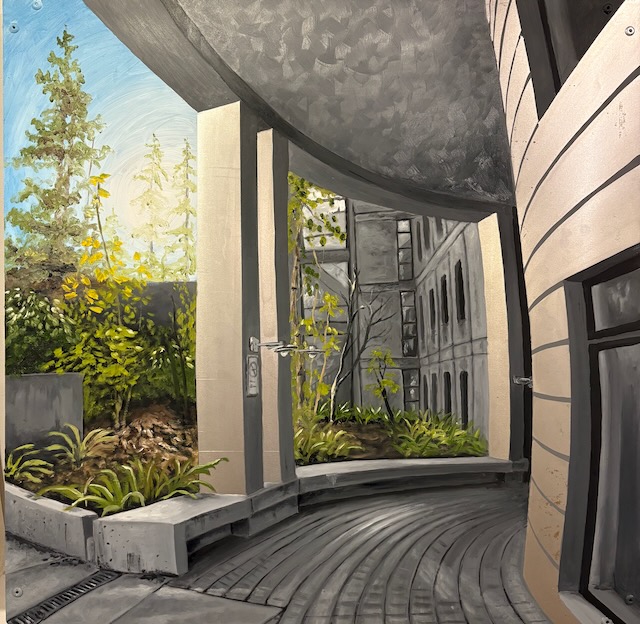
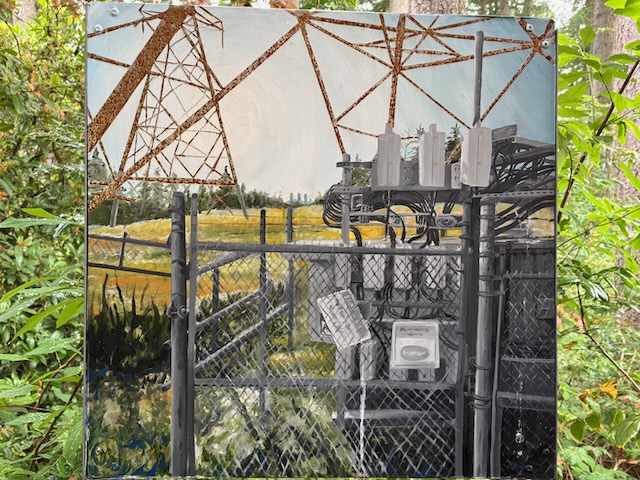
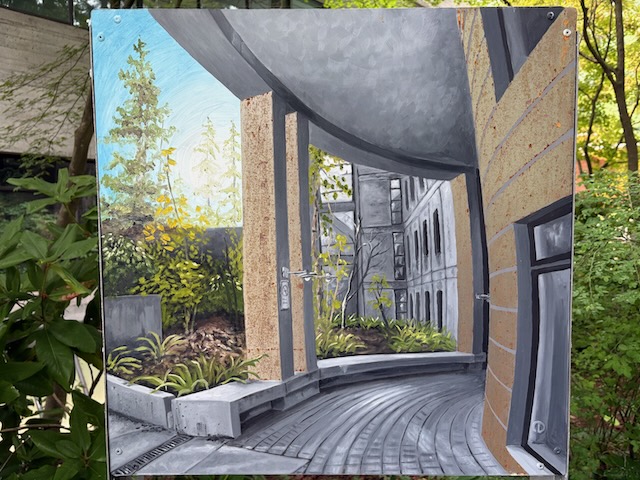
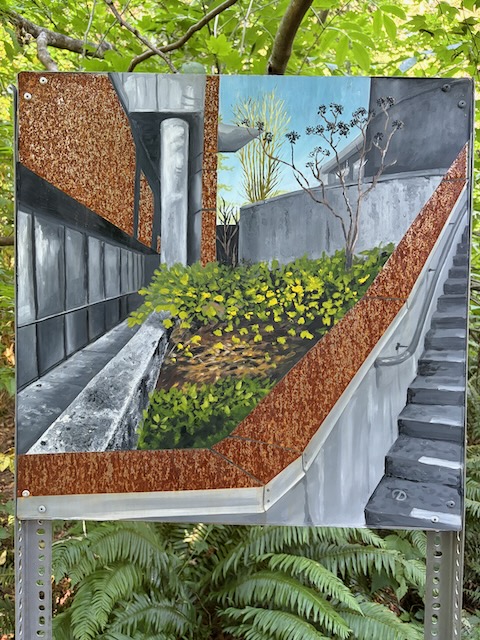
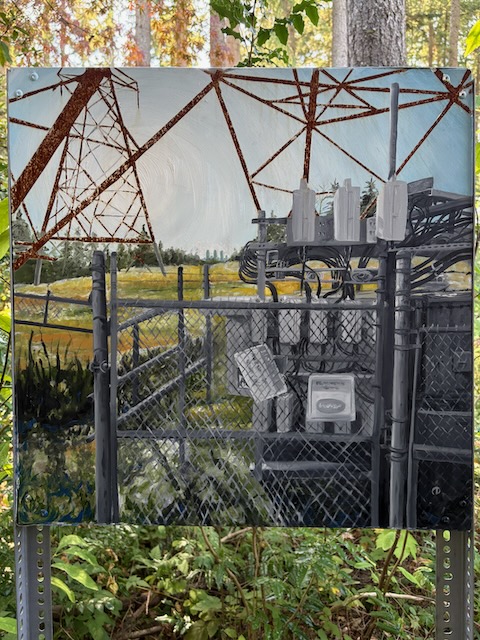
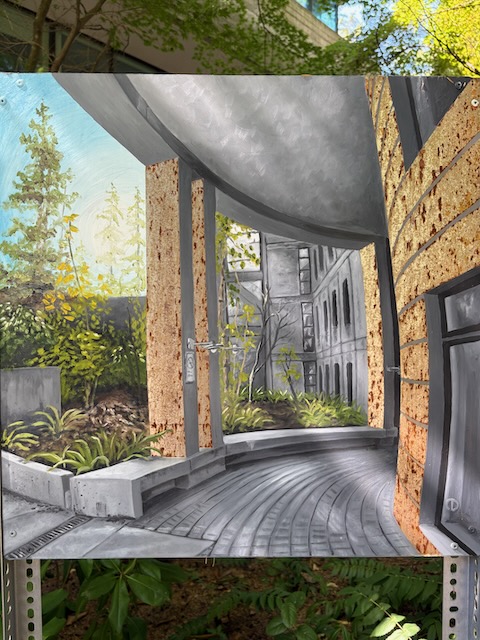
Black, white, and colour. Oil on steel. Echoing realism with cold grey buildings trapping and caging nature. Nature, full of colour with a nod to impressionism. Impressionism was a direct reaction to the industrial revolution and the invention of chemical photography. At the risk of painters losing to a medium that was far faster and less expensive, painters rebelled with fast images that represented light and colour and feeling. This set of three images are all painted on steel plates that I built to look like canvases. They are made with industrial products like construction adhesive, rivets, and bolts and a metal primer. I chose steel for two reasons. The first being that it is made from resources mined and then produced in Canada. Steel manufacturing produces a large amount of atmospheric carbon, and is an essential part of our economy. The second is that it rusts and degrades when not protected. Parts of these images have been left as bare steel so that the images will change over time with exposure to the elements. They live outside, in areas that are nice spots to enjoy nature. They are also depictions of locations in and around the campus. The idea of place is really important to me, and I wanted these paintings to be a conversation about the places they are to be viewed in. I feel that it gives them meaning when we know these places and can reflect on what they are to us in connection to how they are depicted.

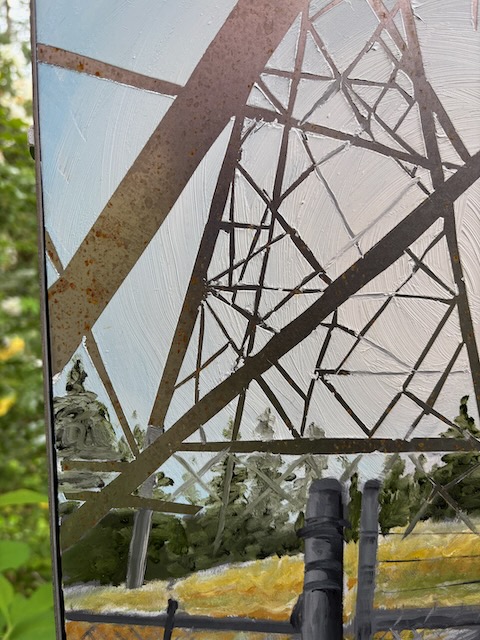
The first image is of the high voltage power lines just behind the campus. I wanted the grasses and trees to feel alive and warm, and for the power lines to feel like a barrier holding us back, warning us of a danger that we created. Power and energy are critical to our modern lives. These power lines are what powers our cities and travel long distances across the land.

The second image is one we are all very familiar with. A set of stairs that climb from the Library up to the Cedar building. One of the things that I love about Capilano University is how entangled the buildings are in nature. It could have been really easy to clear all of the plant life and simply build a school. I took a slightly more cynical look at another way to see this and entrapped nature between buildings. I wanted the trees and shrubs to pop out and have life surrounded and encased by cold glass, cement and steel.

The last image is again a spot we are very familiar with, the curve of the cement walls again entrapping nature, but I wanted to distort the image with a little lens distortion. Again thinking back to a photographic approach to painting, where a lens distorts the world by bending light through glass. It gives the image a slightly surreal feel that I really thought added to shifting perspectives and looking at our environment in new and different ways.
The final piece of this project was to be able to display the paintings and talk to members of the Capilano community before mounting them around campus. I was hoping to really get into discussion about our relationships with nature, but what I found was a little different. The people that I talked to really gravitated towards the steel canvases. Part of that was that it was different and new to them, they really liked the idea that they would change over time and were excited to see how they change and how quickly. The most interesting thing for me was how many people just wanted to touch the exposed steel parts of the paintings. Some of them just went up and touched it before stopping to check if they did something wrong. I found that the idea that we all have embedded in us that art is somehow precious and not to be touched was successfully being challenged by the novelty of the material. I encouraged people to touch them, and found that people were engaging with the paintings exactly as I had hoped. I also asked people as they came through, which paintings drew their attention most and why. For the vast majority of people, images of the buildings or stairs that they walk past every day really pulled them in. It was the familiarity of these places seen in a newperspective that drew their attention.

I want to finish this reflection with a thought on what I have learned through this project. My reason for attending school this year was to build up my credentials towards becoming a teacher. My focus throughout the year has been to look at every one of my courses as what I can take away from them towards that goal. I’ve studied history, math, biology, literature, and sociology. Sociology has shifted the way I approach society and has greatly influenced this project. Not merely because it was done through a sociology course, but because it allowed me to take what I have learned this year about how our society can be studied, and focused it in the form of art. I have developed a strong opinion over the past year that art is a representation of society, and it is a way to study the qualitative aspects of ourselves. Not every element of us can be quantified, and what makes us complex are all of the poetic strings that bind the big ideas together. Unlike writing, paintings are open to interpretation. They are expressions of ideas that are meant to be reinterpreted through the experiences of the individual viewer. At the tume of writing this, these paintings are just waiting for the final approval to be mounted in their new locations around campus, but the story of this project is not quite over yet. Even after mounting, their story will continue. I plan to document how they change over time and am very excited to continue the conversation about our relationship with the environment.
** Update**
The outdoor paintings have been busy changing and reacting to being exposed to the environment. I’m including photos to document the change.
May 17, 2025

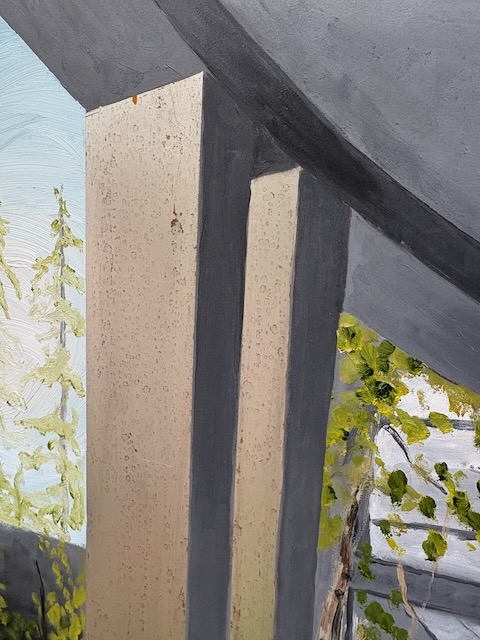
June 21, 2025
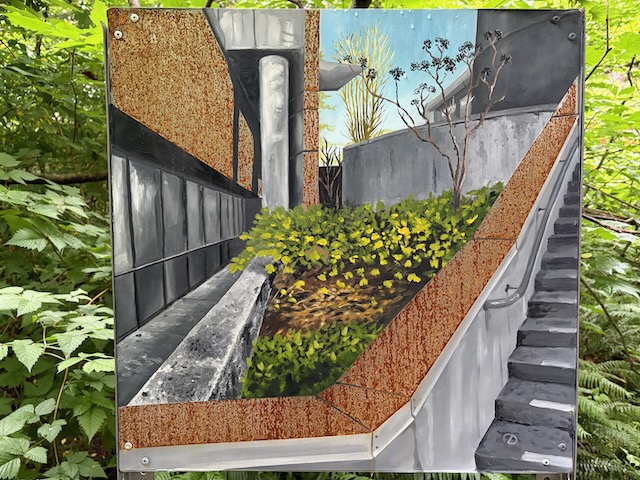
August 27, 2025
 Chris Dalton